From QR Payments to Robotaxis: Freedom Holding’s Partnerships in China
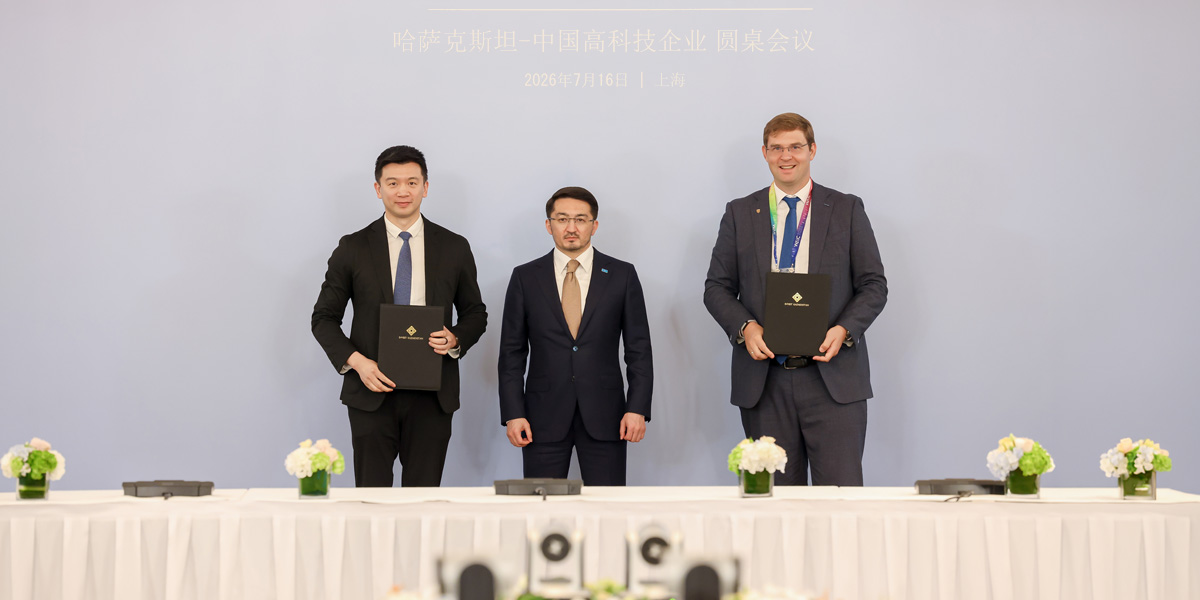
Freedom Holding Corp. has expanded its cooperation with some of China’s largest technology companies. During a visit by the Kazakh delegation to Shanghai, the holding company signed a series of agreements with Tencent, Ant International, Alibaba Cloud, Baidu, Geely, and Heilongjiang Huida Technology. The partnerships cover cross-border payments, artificial intelligence, cloud technologies, autonomous transport, and the digitalization of agriculture.
“I am convinced that Kazakhstan can become a center of technological development in Central Asia. But buying ready-made solutions is not enough—we need to build our own engineering school, develop infrastructure, and localize production,” said Timur Turlov, CEO of Freedom Holding Corp.
WeChat Pay and Alipay: More Convenient Shopping
One of the key agreements was a partnership between Freedom Bank and TenPay Global, part of Tencent, and Ant International, the operators of China’s largest payment ecosystems, Weixin Pay, also known as WeChat Pay, and Alipay.
Once the integration is launched, Freedom SuperApp users will be able to pay for goods and services in China using familiar QR-code payments. They will also be able to shop on major Chinese marketplaces, including Taobao, AliExpress, and 1688. In the opposite direction, the service will allow Chinese tourists to use WeChat Pay and Alipay across Freedom Bank’s payment terminal network in Kazakhstan.
“Historically, Kazakhstan has been the main transit hub between Asia and the rest of the world, and today we are fully digitalizing this ‘bridge,’” the holding company’s CEO said.
In addition to acquiring services, the parties are considering developing cross-border money transfers and settlements in national currencies, including the Chinese yuan. According to TenPay Global, the WeChat Pay ecosystem already supports integration with more than 40 overseas e-wallets from 13 countries and regions.
“We want to learn how to provide direct access to this market so that our consumers can buy goods without enormous markups and on genuinely competitive terms,” Timur Turlov explained.
Geely: Developing Electric Mobility
Geely, one of China’s largest automakers, has become another partner of Freedom Holding Corp. The companies plan to jointly develop electric vehicle infrastructure in Kazakhstan, introduce intelligent solutions in the automotive industry, and explore opportunities to localize the production of charging infrastructure.
It was previously reported that the project would include integrating a network of charging stations into Freedom SuperApp, allowing users to manage the charging process through the holding company’s digital ecosystem.
Baidu: Preparing to Launch Robotaxis
Freedom Holding Corp. has also agreed to cooperate with Baidu, one of China’s largest technology companies and the developer of the Apollo Go autonomous driving platform. The service allows users to order taxis without a human driver.
The parties plan to adapt the robotaxi service for Kazakhstan, taking into account local legislation and road infrastructure. Apollo Go already operates in several Chinese cities and has completed millions of rides using fully autonomous vehicles.
According to Freedom Holding CEO Timur Turlov, combining Chinese technologies with local expertise will make it possible to create a homegrown autonomous transport service for Kazakhstan.
Alibaba Cloud: Cloud Services and Artificial Intelligence
The holding company signed an agreement with Alibaba Cloud, China’s largest cloud service provider, to develop infrastructure and artificial intelligence solutions.
The project includes training specialists, developing cloud services, and establishing a regional center of excellence for Central Asian countries. In the longer term, the partnership will make it possible to use international infrastructure to develop new digital services and AI products.
Heilongjiang Huida: Digitalizing Agriculture
Another area of cooperation is an agreement with Heilongjiang Huida Technology Co., Ltd. The document was signed jointly with Kazakhstan’s Ministry of Artificial Intelligence and Digital Development.
The partnership provides for the localization of agricultural drone production and autopilot systems for farming machinery, the establishment of joint research centers, and the training of specialists in digital agriculture.
Huida is currently considered one of the leaders in China’s precision agriculture market. It develops satellite navigation systems, unmanned aerial vehicles for crop treatment, and digital platforms for monitoring agricultural operations.
International Expansion Continues
All these agreements form part of the international development of the Freedom Holding Corp. ecosystem and the holding company’s efforts to expand its presence in different parts of the world.
In 2025, the company signed an agreement with Japan’s Ledax Co., Ltd. to establish a joint entity specializing in the development of financial services.
In the summer of this year, Freedom Holding Corp. increased its stake in its Japanese subsidiary to 90% to facilitate the launch of its ecosystem in the Japanese market. The remaining 10% is owned by the holding company’s local partner, Ledax Co., Ltd., which operates in the insurance, automotive, and consulting sectors. The ecosystem has invested a total of $500,000 in its new Japanese subsidiary.
Freedom Holding also signed memorandums in Japan with Ledax, Kort Valuta, and Arai Shoji. Arai Shoji became a partner of Arbuz.kz for the supply of Japanese products to Kazakhstan. According to Timur Turlov, the Japanese market is viewed as one of the key stages in exporting the company’s digital ecosystem beyond Kazakhstan.
While the Japanese projects were primarily focused on expanding the company’s international presence, the Chinese partnerships will allow Freedom to integrate advanced payment solutions, artificial intelligence technologies, cloud platforms, and autonomous transport services into its ecosystem. These technologies could become the foundation for new products in the Kazakh market.
Other news
 From First Investments to Nasdaq: How Timur Turlov Built His F...
 Shakhter Returns: How Timur Turlov Is Developing Football in K...
 Freedom Cloud: Why the Cloud Business Matters to Kazakhstan’s ...
 Freedom Yatırım Becomes First Foreign Brokerage in 34 Years to...
 Timur Turlov’s Interview for IntelliNews: why he bids for pres...
 Freedom Holding Corp. Increases Revenue by 40%: What Drove the...
 Timur Turlov’s Interview for China Daily: Learning from China&...
 Freedom Broker Increases Quarterly Revenue by Nearly 68% on St...