Ministry of Artificial Intelligence, Citi, and Timur Turlov Launch Freedom AI Super Cluster
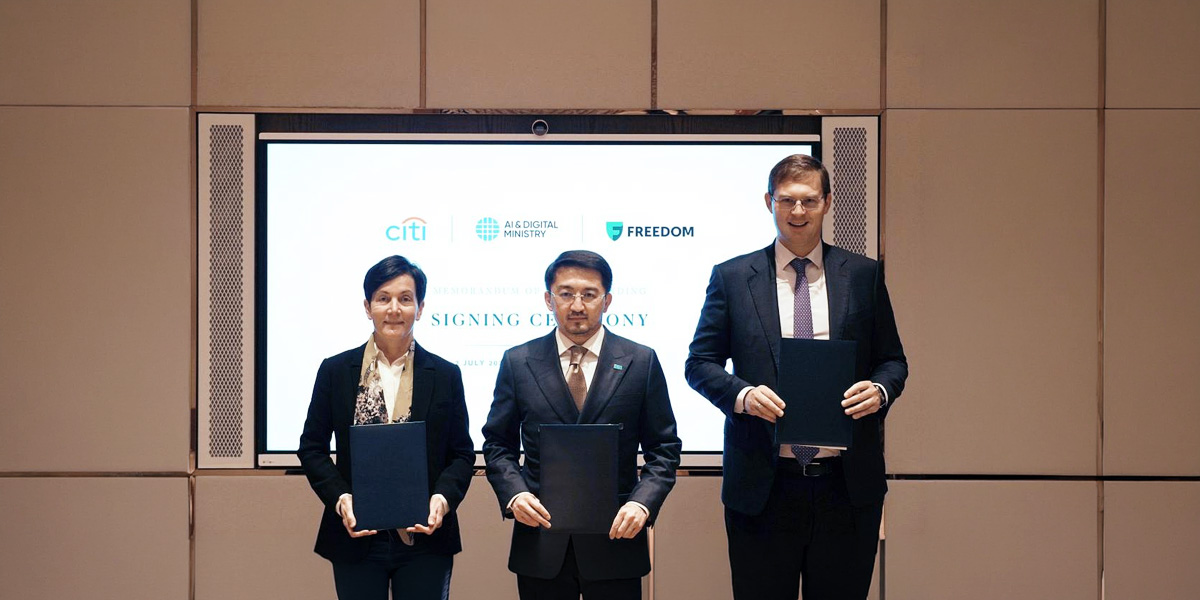
Freedom has signed a trilateral memorandum of understanding with Kazakhstan’s Ministry of Artificial Intelligence and Digital Development and the U.S. bank Citi to establish a world-class AI cluster – the Freedom AI Super Cluster. The project is a high-performance GPU infrastructure cluster designed to provide the computing power required for artificial intelligence applications.
The memorandum was signed during the meeting of the Foreign Investors’ Council attended by President Kassym-Jomart Tokayev. Freedom Holding Corp. CEO Timur Turlov highlighted the government’s consistent efforts to develop the digital economy, emphasizing that further progress in artificial intelligence will require a fundamental modernization of the country’s computing infrastructure.
“The government is taking a highly systematic approach to building the country’s technological future – from adopting a new Constitution to launching major infrastructure projects. In a world where technology agendas often shift with changes in governments and political priorities, this level of consistency is rare, and investors truly appreciate it. It gives them greater confidence and makes it easier to make long-term investment decisions,” Timur Turlov wrote on Instagram.
Turlov noted that the cluster will operate in full compliance with Kazakhstan’s legislation and personal data protection requirements, ensuring secure access to the infrastructure for banks and government institutions. He also announced the creation of a Data Embassy, which will enable Kazakhstan to attract international clients.
“We are entering a new technological era. In the past, everything was built around conventional CPU computing. Today, AI requires an entirely different class of infrastructure – GPU clusters specifically designed for artificial intelligence workloads, with completely different requirements for data centers, cooling systems, and power supply. That is why we are developing the Freedom AI Super Cluster. The first phase will be completed in the first quarter of 2027 and will already represent a significant deployment by regional standards. The second and third phases will be implemented throughout 2027 and 2028,” said Timur Turlov.
The Freedom Holding Corp. CEO also noted that acquiring computing capacity of this scale has become increasingly difficult due to export restrictions and high costs, while global demand for AI infrastructure continues to grow.
“Our goal is to provide this infrastructure because it is as essential as air for artificial intelligence. Without it, neither businesses nor the government will be able to move forward. We are already capable of delivering part of this capacity ourselves, and the memorandum we have signed will help us achieve that,” Turlov concluded.
Freedom Holding Corp., together with Kazakhstan’s Ministry of Artificial Intelligence and Digital Development, is also developing the Sovereign Artificial Intelligence Center based on NVIDIA infrastructure. The project is valued at approximately $2 billion.
In addition, Freedom owns its own data centers and operates Freedom Cloud, a major cloud platform providing businesses and government organizations with infrastructure for data storage, processing, and digital services. In 2025, Freedom Cloud became the first local cloud provider in Central Asia to establish a partnership with Amazon Web Services (AWS), enabling Kazakhstani companies to access AWS technologies through a local partner while supporting the development of hybrid cloud solutions.
Last year, Timur Turlov also invested his personal funds in Akashi Data Center, the largest data center in Central Asia and the region’s first Tier IV-certified facility, currently under construction in Astana. The facility is designed to host mission-critical digital infrastructure, cloud platforms, artificial intelligence services, and high-performance computing (HPC). The project is intended to serve as a foundation for the development of the region’s digital economy and to strengthen Kazakhstan’s technological sovereignty.
Other news
 From First Investments to Nasdaq: How Timur Turlov Built His F...
 “Armenia Can Become a Bridge Between Europe and Central Asia” ...
 Timur Turlov elected FIDE president: what he plans to change i...
 Timur Turlov spoke to ChessBase about what chess teaches us – ...
 FIDE Presidential Election in Samarkand: Timur Turlov’s Campai...
 Freedom Media Agrees to Cooperate with South Korean Broadcaste...
 Freedom Bank Wins Two Awards for Advancing Fraud Prevention...
 “Kazakhstan Will Diversify Its Economy Amid an Influx of Inves...