“Armenia Can Become a Bridge Between Europe and Central Asia” – Timur Turlov
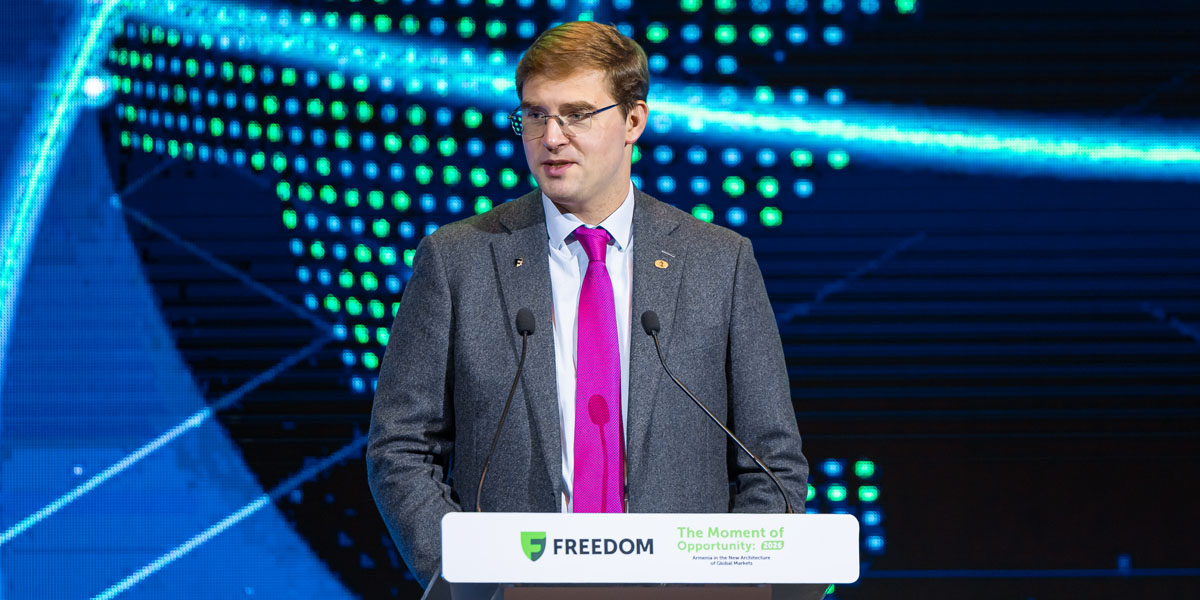
Timur Turlov, founder and CEO of Freedom Holding Corp., spoke at Armenia’s Second Investment and Financial Forum, The Moment of Opportunity: Armenia in the New Architecture of Global Markets. The Moment of Opportunity is a business platform for discussing the development of capital markets, attracting foreign investment, and strengthening Armenia’s role as a financial hub at the crossroads of different regions.
The forum was organized by Freedom’s Armenian subsidiary and brought together representatives of government agencies, the financial sector, international organizations, and technology companies.
Human Capital
Timur Turlov identified human capital as one of Armenia’s key competitive advantages. According to him, the country has specialists capable of developing financial technologies, capital markets, and digital products, while the cost of building such teams remains competitive.
Another advantage is Armenia’s strong ties with its large global diaspora, which helps Armenian businesses maintain connections with international markets. In addition, the country’s favorable geographical location, political neutrality, and relationships with a wide range of countries and economic blocs could further strengthen its regional role.
“Armenia can become a crossroads between Europe and Central Asia. For international investors, stability, openness, and clear rules are essential,” Timur Turlov said.
In his view, it is particularly important for the country to preserve competition. Attempts to protect domestic players through additional barriers may produce short-term benefits, but over time they could slow market development.
Clear and Predictable Rules
Timur Turlov believes that the development of Armenia’s capital market requires a balance between investor protection and sufficient freedom for innovation. The country should take international standards into account, but should not simply replicate foreign regulations without assessing their impact on local businesses.
Flexibility, predictability, and continuous dialogue between regulators and market participants should be the guiding principles.
Armen Nurbekyan, Deputy Governor of the Central Bank of Armenia, shared this assessment. He noted that rising household incomes will increase demand for investment products, although a mature stock market culture is still only beginning to take shape in the country.
According to Nurbekyan, Armenia needs companies that can simultaneously develop investor demand and help local businesses raise capital. Intermediaries can play a key role in this process: initially, individual issuers enter the market, and their example can then encourage a broader wave of participation.
Exporting Financial Services
In recent years, Armenia has increasingly moved toward exporting its services, including financial services, the CEO of Freedom Holding Corp. noted.
“Across the world, we have clients from different countries who use the services of banks, investment companies, and other financial institutions in Armenia,” Timur Turlov said.
This trend is illustrated by the development of Freedom Broker in Armenia, where the company began operating in 2021. Today, the broker serves more than 34,000 clients in the country, including 5,400 who joined since the beginning of 2026. More than 18,000 clients are Armenian residents.
The remainder of the client base is located outside the country, meaning that Armenia’s financial infrastructure is already effectively working as an export industry, the head of Freedom Holding Corp. added.
Freedom Broker Armenia provides clients with access to both local and international stock markets and is wholly owned by Freedom Holding Corp. Through the group’s infrastructure, Armenian investors can trade not only on the domestic market but also on exchanges in the United States and Europe, as well as on platforms within the Astana International Financial Centre.
Building an Investment Culture
According to Timur Turlov, over the past two years the number of transactions handled by Freedom’s Armenian business has increased more than tenfold – from 60,000 to 700,000 transactions per year. The company now intends to broaden the base of retail investors and local issuers, increasing interest in the stock market.
Turlov compared the situation with Kazakhstan in the early 2010s. Fifteen years ago, the country’s Central Securities Depository had around 4,000 individual accounts. Today, millions of participants are registered on Kazakhstan’s stock exchanges, while the market is capable of attracting billions of dollars in investment each year.
In Armenia, according to Turlov, the main shortage is not so much capital as people and companies willing to use the opportunities offered by the stock market. This means that providing technological access to trading alone is not enough.
Freedom Holding Corp., in particular, plans to develop its educational initiatives. Through the group’s academy, tens of thousands of people are already taking courses on equities, government bonds, and the fundamentals of investing.
“We want to create an ecosystem of trust and a new financial culture. Our task is not only to give people a platform, but also to explain how the market works, what opportunities it offers, and what risks investments involve,” Turlov emphasized.
This work should simultaneously increase the number of Armenian investors participating in global markets and attract international capital to Armenia’s domestic market.
Expanding Beyond Brokerage
Freedom Holding Corp. is currently represented in Armenia primarily through its brokerage business, but the company is considering expanding its ecosystem in the country.
Representatives of the holding company have previously said that the group is exploring the acquisition of a bank in Armenia. The company is attracted by the opportunities available in the country: Armenia offers preferential tax conditions for foreign companies operating in free economic zones, making it particularly attractive for businesses.
“Our next step is to further strengthen the ecosystem in Armenia, including the banking and insurance sectors. We will continue working toward obtaining new financial licenses,” Timur Turlov said.
The holding company intends to bring some of the experience it has accumulated in Kazakhstan to the Armenian market. A central element of this model has been Freedom SuperApp – a unified platform combining digital banking, investments, insurance, payments, ticket purchases, and other everyday services.
In Armenia, the platform will need to be adapted to local regulations and user needs. According to the CEO of Freedom Holding Corp., a product cannot simply be transferred mechanically from one country to another: it requires integration with national infrastructure and a high level of data protection.
Other news
 From First Investments to Nasdaq: How Timur Turlov Built His F...
 “Armenia Can Become a Bridge Between Europe and Central Asia” ...
 Timur Turlov elected FIDE president: what he plans to change i...
 Timur Turlov spoke to ChessBase about what chess teaches us – ...
 FIDE Presidential Election in Samarkand: Timur Turlov’s Campai...
 Freedom Media Agrees to Cooperate with South Korean Broadcaste...
 Freedom Bank Wins Two Awards for Advancing Fraud Prevention...
 “Kazakhstan Will Diversify Its Economy Amid an Influx of Inves...