Timur Turlov Calls Tiger Reintroduction in Kazakhstan a Decades-Long Project
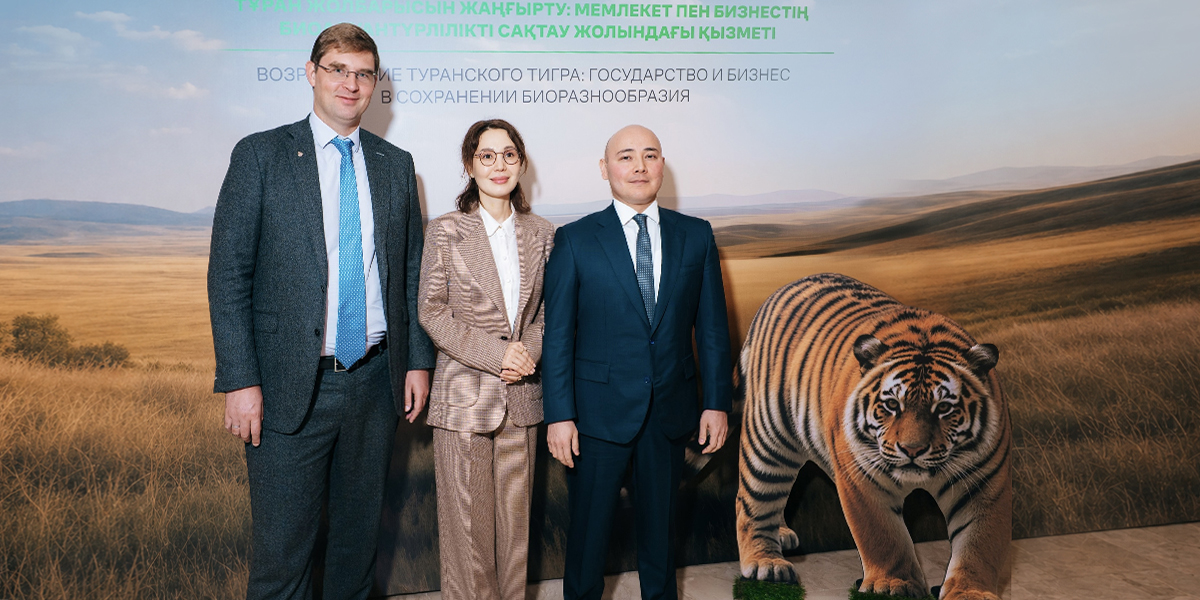
An Amur tiger named Amur has left its adaptation enclosure at Kazakhstan’s Ile-Balkhash Nature Reserve and entered the wild. His relocation from Russia is part of a program supported by Timur Turlov’s holding company. The founder of Freedom sees its primary goal as restoring an entire ecosystem – an effort that will take decades.
Kazakhstan has released a second Amur tiger brought from Russia into the wild as part of efforts to restore the country’s tiger population. The male tiger, named Amur, left his adaptation enclosure at the Ile-Balkhash Nature Reserve on October 31. The project is supported by Timur Turlov’s Freedom Holding Corp., which has allocated more than KZT 100 million to infrastructure, enclosure upgrades and specialist training. The entrepreneur sees the program as an opportunity to restore a natural ecosystem and bring people together around a long-term goal.
From Russia to Their Historical Habitat
Four Amur tigers were transported from Khabarovsk to Kazakhstan’s Almaty Region in May 2026. The first to be released into the wild was a tigress named Umit in July. She is already hunting independently and has established her own territory. Two tiger cubs are still adapting to their new environment in enclosures.
Historically, Kazakhstan was home to the Turanian, or Caspian, tiger, which became extinct in the 20th century. To restore the population, conservationists are using Amur tigers, which are genetically close to the extinct subspecies. Russia’s Amur Tiger Center is helping Kazakh specialists prepare the animals for independent life in the wild.
Results That Will Take Decades
For the founder of Freedom, the return of tigers is an example of a project whose true value will become apparent over many years. Releasing the animals is only one stage of the process: it is also necessary to ensure an adequate prey base, preserve their habitats and create conditions for successful breeding.
“This is a very large and long-term project, expected to take approximately 35 years, because we are talking about restoring an entire ecosystem and creating conditions in which the tiger population can develop sustainably and eventually reproduce on its own,” Turlov explained.
According to Turlov, the scale of the challenge was one of the reasons he decided to support the program. He describes the return of tigers as a remarkable and unique project that the people of Kazakhstan can take pride in. Yet behind the highly visible event of releasing a predator into the wild lies the consistent work of specialists and partners.
Freedom participates in the program through its corporate foundation, Freedom Shapagat, which joined the initiative in November 2024. The holding company financed the training of Kazakh specialists in Russia, upgrades to the enclosures and transportation of the animals.
Turlov emphasizes that these investments also lay the groundwork for future stages of the program. The infrastructure can be used to accommodate additional tigers, while the expertise gained will remain with the team. The partnership with Kazakhstan’s Ministry of Ecology also includes support for unforeseen expenses, which are inevitable when working with wildlife.
How Freedom Ecosystem Customers Can Participate
Another goal Turlov has set is to make the return of tigers a project in which Kazakhstanis themselves can participate. In early 2027, Freedom plans to launch a special bank card to support the program.
According to the entrepreneur, whenever customers make a purchase using the card, the bank will contribute an amount equivalent to 10% of each transaction to the tiger conservation fund at its own expense. Customers will forgo cashback in favor of supporting the conservation initiative. A similar mechanism is already used with the Araldy Saqta environmental card: by making purchases with it, Freedom Bank customers help finance efforts to restore the Aral Sea ecosystem.
For Turlov, the purpose of this participation is to achieve a shared result that will become visible over time. He hopes to bring together business support, the work of conservation specialists and customers’ everyday contributions around the common goal of restoring nature.
“And I will be very happy if, many years from now, we can look back and say that together we accomplished something truly significant for our country, and that real Amur tigers are once again living in Kazakhstan,” the entrepreneur emphasized.
Other news
 From First Investments to Nasdaq: How Timur Turlov Built His F...
 Timur Turlov Calls Tiger Reintroduction in Kazakhstan a Decade...
 Timur Turlov: “FIDE should become the regulator for online che...
 Kazakhstan as an AI Computing Hub: Timur Turlov’s Projects and...
 Timur Turlov: “Chess Has Every Chance of Becoming as Popular a...
 From Travel to Groceries: How Freedom Holding Corp.’s Lifestyl...
 Freedom Holding Corp. Marks Seven Years Since Its Nasdaq Listi...
 Timur Turlov Meets with NIS Students in Almaty to Discuss Lead...