Timur Turlov Meets with NIS Students in Almaty to Discuss Leadership, Entrepreneurship, and the Future of AI
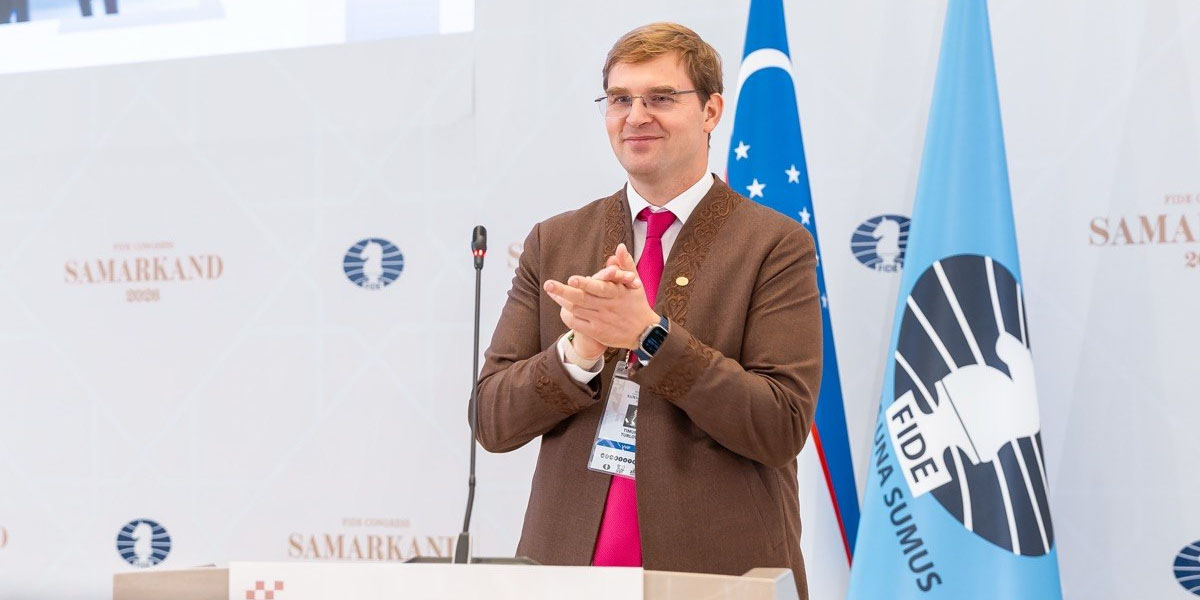
On October 9, Timur Turlov met with students of Nazarbayev Intellectual School (NIS) in Almaty. The students asked the entrepreneur about his election as FIDE President, his career, leadership, artificial intelligence, and Kazakhstan’s future. Turlov shared his personal experience and offered advice to the younger generation.
On Chess and His Victory in the FIDE Presidential Election
The students congratulated Turlov on his election as President of the International Chess Federation (FIDE) and asked how he felt when the results were announced. He admitted that the election had been more challenging than he initially expected.
“It was the first time I had participated in such a competitive election within a public organization, and I gained tremendous experience. I sincerely encourage you to get involved in extracurricular and community activities at your school and in other clubs. This kind of work pushes you to develop a wide range of skills,” Turlov said.
Reflecting on the two rounds of voting, he emphasized that one of the most important lessons of the campaign was the value of trust and reputation.
“Never sacrifice long-term advantages for short-term gains. It is extremely important to keep your word, carefully consider what you promise and to whom, and then fulfill those promises. That is how you are judged not only by your classmates at school, but also by world leaders,” he noted.
He added that Kazakhstanis’ achievements in international competitions contribute to the country’s global reputation.
On Education and His First Steps in Business
The students pointed out that Turlov began working in financial markets at around the age of 16 or 17 and asked what advice he would give to young people choosing their future paths. He encouraged them not to pursue an idealized version of life.
“Don’t try to force your life into a predefined pattern. We all make mistakes, and no two lives are the same. Sometimes things turn out much better than you imagined. And sometimes what you thought would be your life’s calling turns out not to be your calling at all,” the entrepreneur said.
Asked what he would choose at 17 – attending university or launching his own startup – Turlov admitted that, knowing what he knows today, he would probably choose university. He studied while working full-time and eventually started his own business after losing his job.
“If I hadn’t been laid off, I might never have started my own business. When the global financial crisis hit, my employer shut down the entire division where I worked. I thought that since finding another job would be quite difficult, why not start my own company?” he recalled.
At the same time, Turlov cautioned students against investing significant resources in areas they do not fully understand.
“When you enter a field in which you are not yet an expert, the chances of making money are extremely low. You will be paying for your experience – with your time, your money, and sometimes even damaged relationships.”
On Leadership and Building Strong Teams
One student asked how to distinguish a genuinely promising employee from someone who simply knows how to make a good impression. According to Turlov, true leaders are capable of inspiring others and challenging ideas with well-reasoned arguments.
“You can often recognize leaders by their enthusiasm and their ability to inspire others. They may disagree on certain issues, but their disagreements are based on information and thoughtful decisions. These are people who are willing to take responsibility, are not afraid to take risks, and can convince others to do the same,” he explained.
He also encouraged students not to avoid uncertainty.
“Don’t be afraid to take responsibility, especially when nobody knows how things will turn out. People dislike uncertainty, and in those moments, they often prefer to let someone else make decisions for them. Be the person who says, ‘I’m ready to take responsibility. I believe we can make this work,’” Turlov said.
Asked about talented but difficult employees, he explained that exceptional professionals are worth fighting for, as long as disagreements do not begin to undermine the team.
“When you surround yourself with stars, they are rarely easy to work with. You have to fight hard to keep these people. But we accomplish truly great things together.”
On Artificial Intelligence and the Jobs of the Future
The students also asked which skills would remain valuable if artificial intelligence surpassed humans in programming, writing, and other intellectual tasks. Turlov believes that creativity and the ability to set goals independently will remain essential human strengths.
“Modern artificial intelligence does not have the ability to set its own goals. What will remain most important is creativity and goal-setting. The more creative your profession is, the more it involves making decisions, imagining new possibilities, coming up with ideas, and addressing ethical questions, the more likely it is to remain in demand,” he explained.
To illustrate his point, Turlov referred to chess, where computers have long outperformed human players without making human competitions any less meaningful.
“People play against other people, and it doesn’t matter that computers can calculate better. People will continue to interact with one another,” he emphasized.
On Kazakhstan’s Future
Discussing Kazakhstan’s prospects, Turlov highlighted education, human capital, and innovation as essential drivers of economic growth. In his view, natural resources alone cannot guarantee long-term prosperity.
“Clearly, the wealthiest countries will be those with the best-educated populations. Not those with the most oil or uranium, even though we have been blessed with an incredibly resource-rich country. The wealthiest nations will be those that have managed to achieve a high level of human capital,” he said.
He also identified Kazakhstan’s young population and its potential to export digital ecosystems as important competitive advantages.
At the end of the meeting, the students asked Turlov what he would like one of them to thank him for twenty years from now.
“Probably for inspiring them not to be afraid to take responsibility and make that first step into the unknown. Because our entire future is always, to some extent, unknown,” the entrepreneur concluded.
Other news
 From First Investments to Nasdaq: How Timur Turlov Built His F...
 Timur Turlov Meets with NIS Students in Almaty to Discuss Lead...
 President Tokayev Congratulates Timur Turlov on His Election a...
 Timur Turlov: Freedom Is Developing an AI Assistant for Custom...
 “Armenia Can Become a Bridge Between Europe and Central Asia” ...
 Timur Turlov elected FIDE president: what he plans to change i...
 Timur Turlov spoke to ChessBase about what chess teaches us – ...
 FIDE Presidential Election in Samarkand: Timur Turlov’s Campai...