Timur Turlov elected FIDE president: what he plans to change in world chess
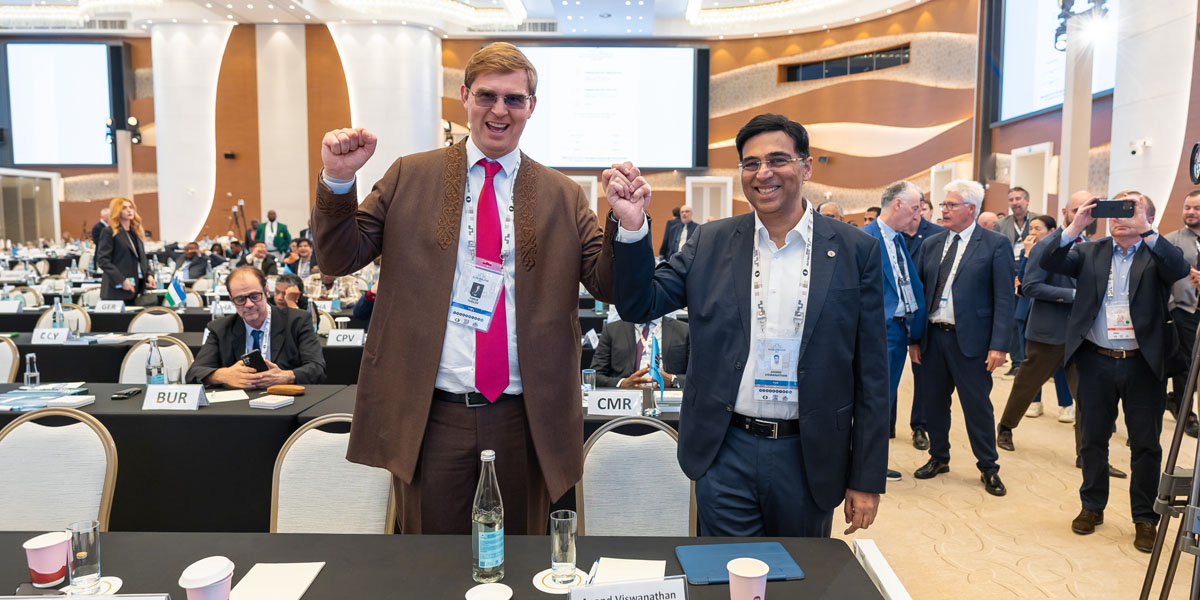
For the first time in history, the International Chess Federation is headed by a citizen of Kazakhstan: Freedom Holding Corp. founder and CEO Timur Turlov has been elected the new president of FIDE. His program includes multi-million-dollar investments, a unified digital profile for chess players, and equal access for national federations to funding and infrastructure.
Freedom Holding Corp. founder and CEO Timur Turlov won the election for president of the International Chess Federation (FIDE). At the organization’s General Assembly in Samarkand, he received 110 votes in the second round of voting. Vadim Rosenstein received 85 votes. The third candidate, Jan-Henric Buettner, received 20 votes in the first round and did not take part in the second round.
“I would like to thank my campaign team and the delegates of the national federations for supporting my candidacy and believing in my program for the development of FIDE and our sport. For me, this is a great responsibility and an excellent opportunity to make FIDE a modern, open, and financially sustainable organization that creates more opportunities for the development of chess and players in every country,” Timur Turlov said after the vote.
He became the ninth president in FIDE’s more than century-long history. He is also the first citizen of Kazakhstan to hold the post. Viswanathan Anand, a five-time world champion who remained one of the strongest chess players on the planet for more than two decades, will serve as vice president as part of Turlov’s team. Anand had served as FIDE deputy president since 2022.
How Timur Turlov plans to lead FIDE
“If you want to lead FIDE, you have to be ready to speak directly and answer difficult questions. When a tough question arises, the president should answer it himself. Public discussion is part of the job, even when it becomes uncomfortable. My approach will not change after the election. My professional background is in business, but I understand that FIDE operates by different rules. Its success cannot be measured only by revenue or the number of contracts. FIDE exists for national federations and for the people who play chess,” he said on the day of the FIDE presidential election.
Timur Turlov noted that the federation must take into account the differences among more than 200 countries: some receive substantial government support, while others depend on only a few enthusiasts. According to him, FIDE should help each national federation find its own model for growth.
Turlov added that commercial partnerships should provide the organization with financial sustainability without turning it into a business: the resources raised should be directed toward developing chess. He also expressed a willingness, after the election, to adopt strong ideas from the programs of his rivals Vadim Rosenstein and Jan-Henric Buettner and to work with them wherever it would benefit the chess community.
Millions of dollars for chess development
The new president’s program is built around four priorities: financial sustainability, stronger FIDE institutions, digital transformation, and the development of chess in education.
From 2027 to 2030, €6.2 million (about $7.07 million) is expected to be allocated to the development fund each year. That is 3.9 times the current level of funding of €1.6 million (about $1.82 million). Over four years, the fund could total €24.8 million (about $28.3 million).
The program also provides for three years of individual support for ten young chess players – five boys and five girls.
In addition, from 2027 to 2030, a FIDE media fund of $1.5 million per year will operate. Turlov’s total guaranteed personal commitment to this initiative amounts to $6 million. This is long-term funding, not a one-time investment.
Of the media fund’s annual budget, $1 million, or 67%, is planned for national projects and information campaigns. Another $200,000, or 13%, will be allocated to developing the communications capabilities of national federations and training specialists. A further $100,000, or 7%, will go toward shared tools and program support. All FIDE national federations will be able to apply for funding.
Turlov also plans to introduce public-company governance standards at FIDE: independent audits, regular financial reporting, and disclosure of major commercial agreements. In his view, transparency should strengthen the confidence of federations, sponsors, and partners.
“Any ambitious strategy makes sense only when it is backed by the ability to fulfill commitments, because that is how trust is built. In Kazakhstan, we have already seen the results of this approach; now our task is to scale this experience internationally,” the new FIDE president said.
A digital profile for every chess player
One of the central projects will be a unified FIDE digital ecosystem connecting players, coaches, tournament organizers, and national federations. A personal FIDE ID could include a player’s rating, game and achievement history, tournament registration, and access to educational materials.
Artificial intelligence is expected to be used for game analysis, player and coach preparation, tournament administration, and detecting cheating. Federations will also be offered tools for managing ratings, organizing tournaments, and reducing paperwork.
In professional chess, Turlov proposes publishing a calendar of major events two years in advance, steadily increasing prize money, and improving conditions for players. A separate part of the program focuses on women’s chess: funding for relevant competitions is planned to increase from $100,000 to $500,000, while the share of women in FIDE’s governing bodies is to rise to at least 35%.
Kazakhstan’s experience for FIDE
Turlov entered the election as president of the Kazakhstan Chess Federation, which he has led since January 2023, and as head of the International School Chess Federation. During this period, Kazakhstan built a system bringing together the state, business, schools, and the professional chess community.
By the end of September, chess programs had reached 2,500 schools and 133,000 children. The country hosts 300–400 competitions each month, and over three years their total number exceeded 10,000. Universities began training chess teachers, while KazChessLab laboratories and a digital accreditation system for clubs and schools were introduced.
In 2025, Kazakhstan’s chess players won 162 medals at international competitions, including 64 gold medals – 16% more than a year earlier. Over the past four years, the country has hosted six major FIDE events, ranging from a world championship match to the World University Team Chess Championship.
From family games to leading world chess
Turlov’s interest in chess began in childhood: his grandfather taught him to play when he was about five. He was unable to study the game systematically at the time and returned to it as an adult thanks to his children. When they started attending a chess club in Almaty, Turlov began playing with them, training with the same coach, and later supporting the club itself.
“At first, I started helping the chess club my children had begun attending. I think that was my first step,” he recalled.
His next major project was supporting a stage of the FIDE Women’s Grand Prix in Astana. Gradually, a personal interest grew into systematic work to develop chess.
For the father of six children, chess remains a way of spending time with family and a tool for developing concentration. Turlov believes the game helps children sustain attention for longer, anticipate the consequences of their decisions, and become less dependent on constant smartphone use.
Chess has also influenced his approach to business. Turlov has said that the game helped him notice how fatigue, lack of sleep, and stress reduce the quality of decisions. Another important skill has been the ability to consider several scenarios in advance and prepare for different actions by a partner or opponent.
Other news
 From First Investments to Nasdaq: How Timur Turlov Built His F...
 Timur Turlov elected FIDE president: what he plans to change i...
 Timur Turlov spoke to ChessBase about what chess teaches us – ...
 FIDE Presidential Election in Samarkand: Timur Turlov’s Campai...
 Freedom Media Agrees to Cooperate with South Korean Broadcaste...
 Freedom Bank Wins Two Awards for Advancing Fraud Prevention...
 “Kazakhstan Will Diversify Its Economy Amid an Influx of Inves...
 From Groceries to Travel: Freedom Holding Corp.’s E-Commerce S...