FIDE Presidential Election in Samarkand: Timur Turlov’s Campaign
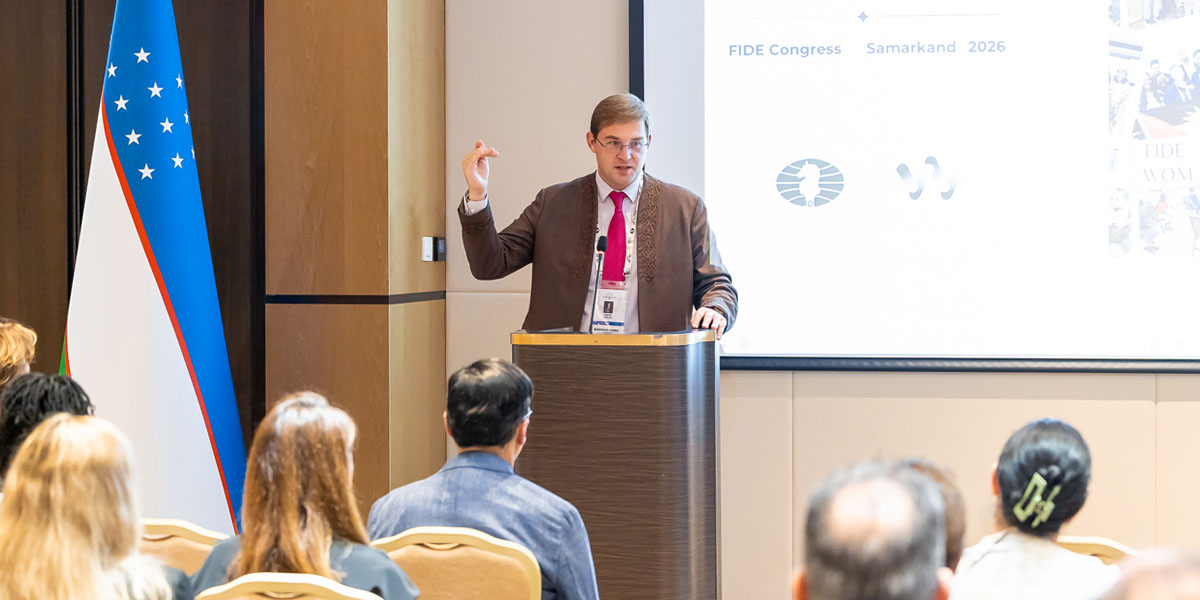
Timur Turlov describes chess as a universal language that brings people together and helps unlock Kazakhstan’s intellectual potential. He now intends to bring the experience of developing the national federation, school chess programs and international tournaments to the FIDE level, with the presidential election scheduled to take place in Samarkand on September 26.
Professional governance, digital services, sustainable financing and accessible school programs should form the foundation for the further development of chess worldwide, Turlov believes. In the FIDE presidential election in Samarkand, he will run alongside five-time world champion Viswanathan Anand.
The 46th World Chess Olympiad has begun in Samarkand, bringing together national teams from around the world. The competition features around 400 open and women’s teams from more than 200 countries, setting a record in the history of the tournament. The event is being played under the Swiss system over 11 rounds, with each team consisting of four main players and one reserve. The FIDE Chess Olympiad for People with Disabilities and the FIDE Congress are also being held in Samarkand at the same time.
Kazakhstan’s women’s team started the tournament with five consecutive victories. In the fifth round, the team defeated Germany 2.5–1.5 and moved into third place. Meruert Kamalidenova secured the decisive point by defeating Hanna Marie Klek on move 31. Bibisara Assaubayeva, Alua Nurman and Elnaz Kaliakhmet drew their games.
Kazakhstan’s men’s team drew 2–2 with Estonia in the fifth round. A total of 398 teams and almost 2,000 chess players are participating in the Olympiad. The competition will continue through September 27.
Three Candidates for FIDE President
At the same time, the city is preparing for the election of the president of the International Chess Federation. The FIDE leadership election will take place on September 26 during the organization’s General Assembly. Each national federation represented at the Assembly has one vote.
Three teams have been admitted to the election. Freestyle Chess co-founder Jan Henric Buettner is running with Malcolm Pein, WR Chess founder Wadim Rosenstein with Gordon Tang, while Freedom Holding Corp. CEO Timur Turlov is running together with chess grandmaster Viswanathan Anand.
Anand has won the world championship five times and remained among the world’s strongest chess players for more than two decades. Since 2022, he has served as FIDE Deputy President. Turlov’s team combines Anand’s sporting experience with expertise in management, digitalization and attracting long-term financing.
The Fintech Candidate’s Plans
Turlov’s platform is built around four main areas: digital transformation, the development of chess in education, financial sustainability and strengthening FIDE’s institutions.
The candidate proposes creating a unified digital ecosystem connecting players, coaches, organizers and national federations. It could include a digital FIDE ID, an educational platform, databases and tools for organizing competitions.
Another initiative is a development fund of more than $6 million. The funds are intended to support open tournaments, the training of coaches and arbiters, travel assistance for chess players and the development of infrastructure in countries with limited financial resources.
Other elements of the platform include establishing an international calendar well in advance, creating a predictable World Championship cycle, increasing prize funds, developing women’s and school chess, supporting players and improving transparency within FIDE. All national federations, regardless of their size, should have equal access to services and development programs.
Turlov also proposes introducing modern anti-cheating technologies and considering biometric identification for participants in official online tournaments. In FIDE governance, he intends to apply standards used by publicly listed companies, including independent audits, transparent reporting and clear oversight mechanisms.
A Game Since Childhood
Turlov’s interest in chess began in childhood, when his grandfather taught him how to play. He later returned to the game through his children. The businessman has said that chess became a shared activity for his family and a way to build meaningful communication with his six children.
In his view, chess teaches not only how to calculate several moves ahead but also how to deal calmly with defeat. Children see the connection between decisions and their consequences, learn to analyze mistakes, control their emotions and take responsibility for results.
“Chess is a universal language, a game that allows us to overcome borders and find common ground. For us, it is an opportunity to present Kazakhstan as a country with strong intellectual potential,” Turlov has said.
He sees chess as more than just a professional sport. It is an intellectual environment that brings together people from different countries and industries, including the financial sector. For this reason, Freedom organized corporate tournaments and began supporting major international competitions even before Turlov became head of the national federation.
From Supporting Tournaments to Systematic Development
Close cooperation with chess organizations began in 2022, when Freedom supported the World Rapid and Blitz Chess Championships in Almaty and a stage of the FIDE Women’s Grand Prix in Astana. In January 2023, Turlov became president of the Kazakhstan Chess Federation, and since 2024 he has headed the International School Chess Federation.
“I sincerely believe that this is a game that teaches us to better understand ourselves, how our brains work and how we make decisions. It teaches us to concentrate and maintain attention, something that is becoming increasingly difficult for both us and our children,” Turlov has said.
After he took over the national federation, it strengthened its team and brought in new specialists, including employees of Freedom Holding Corp. Some of the work that had previously relied largely on enthusiasm was placed on a professional footing: employees were given the opportunity to work on chess development on a permanent, paid basis. The holding company also provides the federation with management expertise and assists with event organization, financing and strategic planning.
One of the main results has been the expansion of school chess. In 2026, chess was introduced as a school subject in 1,500 schools across Kazakhstan, with plans to extend the program to 2,500 educational institutions the following year. Turlov believes that Kazakhstan’s model could also be adapted for other countries.
He also links support for chess to the creation of social mobility opportunities: expanding access to training and tournaments gives children from different regions the chance to demonstrate their abilities, enter the professional environment and represent their country internationally, the entrepreneur believes. At the same time, players’ achievements and the hosting of major competitions help strengthen Kazakhstan’s image abroad as a country with significant intellectual potential.
Kazakhstan’s Experience for the Global Federation
At the FIDE level, Turlov wants to combine sporting expertise with professional management. A stable calendar and transparent rules should make chess more attractive to broadcasters and sponsors, while additional financing could support federations in Africa, Latin America and other regions.
At the same time, he says corporate management methods should not replace the sporting dimension. This is why Anand, representing the professional chess community, is part of his team.
During the Olympiad, Turlov plans to meet with players, organizers, fans and leaders of national federations. For him, Samarkand is an opportunity not only to present his own platform but also to hear what the chess community expects from FIDE’s future leadership.
The candidate’s main objective is to turn the current growth of interest in chess into a sustainable global movement and make FIDE a stronger, more independent, technologically advanced and open organization.
Other news
 From First Investments to Nasdaq: How Timur Turlov Built His F...
 FIDE Presidential Election in Samarkand: Timur Turlov’s Campai...
 Freedom Media Agrees to Cooperate with South Korean Broadcaste...
 Freedom Bank Wins Two Awards for Advancing Fraud Prevention...
 “Kazakhstan Will Diversify Its Economy Amid an Influx of Inves...
 From Groceries to Travel: Freedom Holding Corp.’s E-Commerce S...
 S&P Global Ratings and Moody’s Upgrade Ratings of Freedom...
 Shakhter Returns: How Timur Turlov Is Developing Football in K...