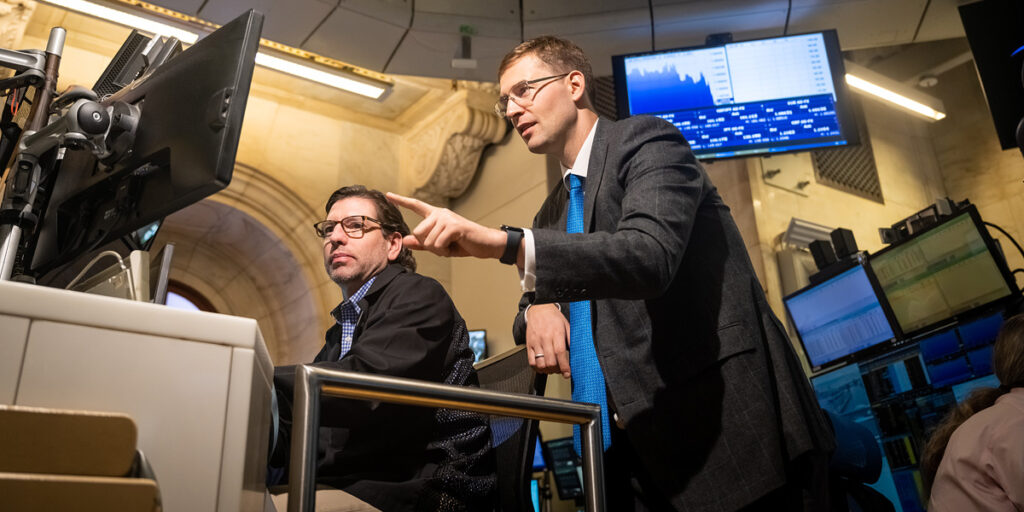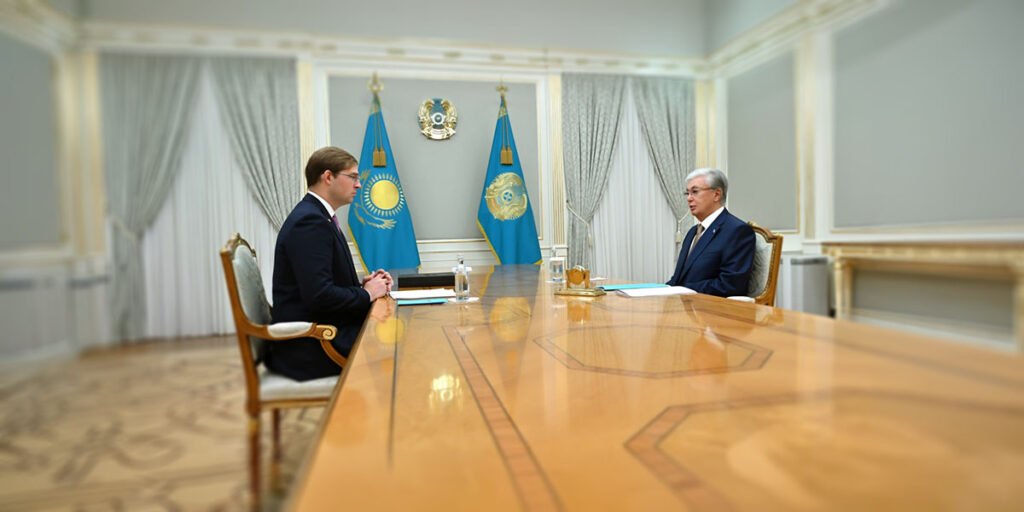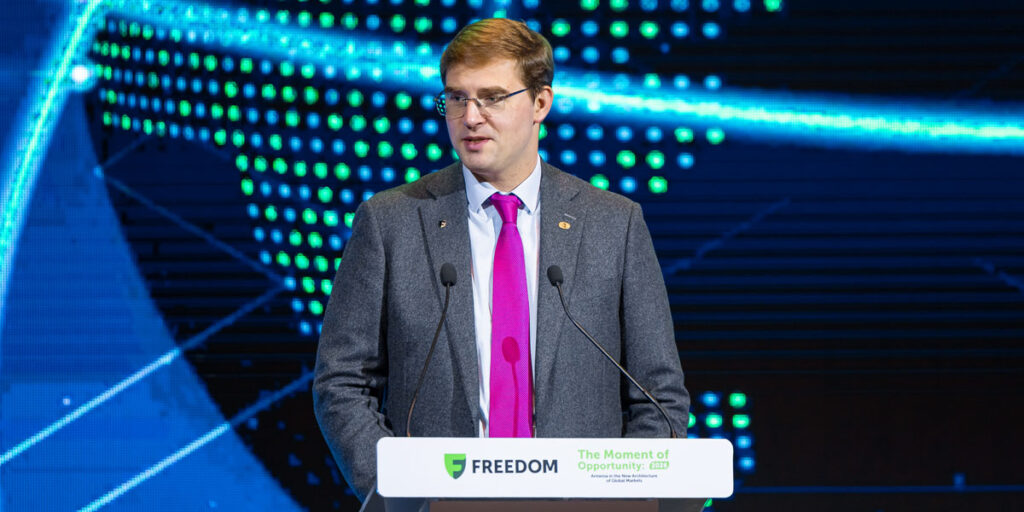
Today, Kazakhstan has hundreds of thousands of skilled workers who are capable of making world-class products, writes Timur Turlov, CEO of Freedom Holding. This photo was taken at Stanford University, where he spoke in late May 2026. Photo: Timur Turlov / Facebook.com
Industrial economies created industrial conglomerates, digital economies create ecosystems, and the export of knowledge and technology is becoming the highest form of non-commodity exports. In this column for OnInvest, Timur Turlov, founder and CEO of Freedom Holding Corp. (FRHC), reflects on these trends.
Every era of the global economy has been built around a particular source of wealth. Agrarian economies revolved around land and agriculture. They were replaced in the industrial era, when factories, plants, and mass production became the main drivers of growth. That, in turn, gave way to the postindustrial economy, where knowledge, technology, and services began to play an increasingly important role. Today, services – especially digital services – account for a large share of exports from developed economies.
Some of the most important U.S. export products now are cloud services, software, and digital platforms. Millions of companies around the world rely on Amazon Web Services and Microsoft Azure cloud infrastructure, Microsoft’s enterprise solutions, Salesforce services, and cybersecurity and data analytics products.
According to the U.S. Bureau of Economic Analysis, exports of U.S. services exceeded $1.1 trillion for the first time in 2024. Among the fastest-growing categories were telecommunications, computer and information services, financial services, and other business services. The AI segment is leading the growth. Companies and users around the world pay for access to computing power, AI models, and next-generation digital services. A ChatGPT subscription or use of OpenAI’s API is just as much an export of a digital service as a cloud platform or enterprise software.
If we see this as a shift in the economic order, then ramping-up industrial capacity and exports of goods already looks like an outdated strategy. China is now the undisputed leader in manufacturing and merchandise exports, having become the world’s factory floor. Yet its GDP per capita remains lower than Kazakhstan’s, at $13.3k versus $14.2k in 2024. This demonstrates that the growth potential of manufacturing economies is limited and that industrial capacity alone is insufficient to create truly wealthy countries. Today, most value creation and wealth generation comes from exports of services.
Moreover, over the next few years – likely within five years – we will see a robotics revolution as robots begin replacing people in manufacturing. With the emergence of humanoid robots, production facilities will no longer require workforces of their current size. Plants will evolve into so-called “dark factories,” operating with minimal human involvement.
As a result, the cost of manufacturing goods will decline and products will become more affordable. Most value added will no longer be created in the production of goods, but in the creation of the robots themselves. Greater value will accrue not to those who own factories, but to those who develop robots, write software for them, train AI models, and manage digital infrastructure. The work of managing robots will be compensated more highly than that of producing goods is today.
That is why knowledge and technology will become the key assets of the future economy. If the industrial era rewarded those who knew how to build factories, the next era will reward those who create software, algorithms, and digital platforms. The export of technology and digital services will become the main driver of growth for countries.
At the same time, when we talk about exporting technology and digital services, it is important to think in terms of building ecosystems rather than individual technology companies. Nvidia illustrates this well. The company does not simply produce chips – it owns CUDA, the software ecosystem on which a significant share of modern AI software runs. Abandoning it is about as difficult as abandoning Windows. There is no shortage of chipmakers in the world – AMD, Huawei, and others all produce chips. In some respects, their products are comparable to Nvidia’s. Yet they are harder to work with because of differences in architecture, programming languages, and processor types.
The Nvidia example reflects a core principle of the digital world: the winner takes all. Google, Instagram, and TikTok are used globally. Everyone else must compete not with a single product, but with an entire ecosystem of developers, libraries, tools, and software. The greatest value lies not even in the device or software itself, but in the environment that forms around it. This principle also applies to digital banks: whoever succeeds in creating and exporting an ecosystem will capture the greatest value. Kazakhstan today has every opportunity to do exactly that.
The country has built a unique regulatory environment in which such innovation can emerge: an open government, a techno-optimistic society, and a large pool of educated workers developed through government efforts to send young people to study at leading universities around the world. Kazakhstan now has hundreds of thousands of qualified specialists capable of building world-class products, while the existing regulatory framework makes it possible to launch such products quickly. That is why large and successful ecosystems have already begun to emerge in the country.
The next step is to scale these ecosystems and export them abroad. By conducting transactions through our channels, people around the world will generate foreign-currency revenue for the bank and the broader ecosystem in the form of fees, software licensing payments, and subscriptions to the AI models we are rolling out. That revenue will flow back into our country. Of course, exporting technology is not easy and requires building a reputation. But we are already demonstrating that it can be done. At Freedom, we believe we should be the first – but not the only one.
South Korea’s economic success story shows how important national champions can be to a country’s development. In the second half of the twentieth century, the large industrial groups known as chaebols became engines of South Korea’s economy, while the government helped them enter international markets and created conditions for business expansion. Whereas the industrial era created chaebols such as Samsung, Hyundai, and LG, the digital era is creating ecosystems that combine finance, technology, e-commerce, AI, and digital services. Modern digital holdings are a new generation of national champions built around data, technology, and software. The government of Kazakhstan is also providing diplomatic support to national champions today, and that support helps drive service exports more than almost anything else.
If Kazakhstan truly wants to increase the share of non-commodity exports in its economy, one of its key priorities should be supporting companies capable of competing in global technology and digital-services markets. This support should not be limited to diplomacy and reputation-building. It should also involve national capital, institutional investors, and development funds that can help businesses scale beyond the domestic market.
The export of digital services represents the highest form of non-commodity exports. Unlike manufacturing, where much of the competition revolves around scale, production costs, and access to resources, digital products can be scaled internationally with virtually no limits. It is the creation and export of digital services, knowledge, and technology that generates the greatest value. The next stage of Kazakhstan’s economic development may therefore be driven less by manufacturing and more by the creation and export of its own digital ecosystems. If the country wants to secure a place among the world’s most advanced economies, it must become not only a supplier of resources, but also a supplier of technology.