Freedom Case Study was Discussed at Stanford Graduate School of Business
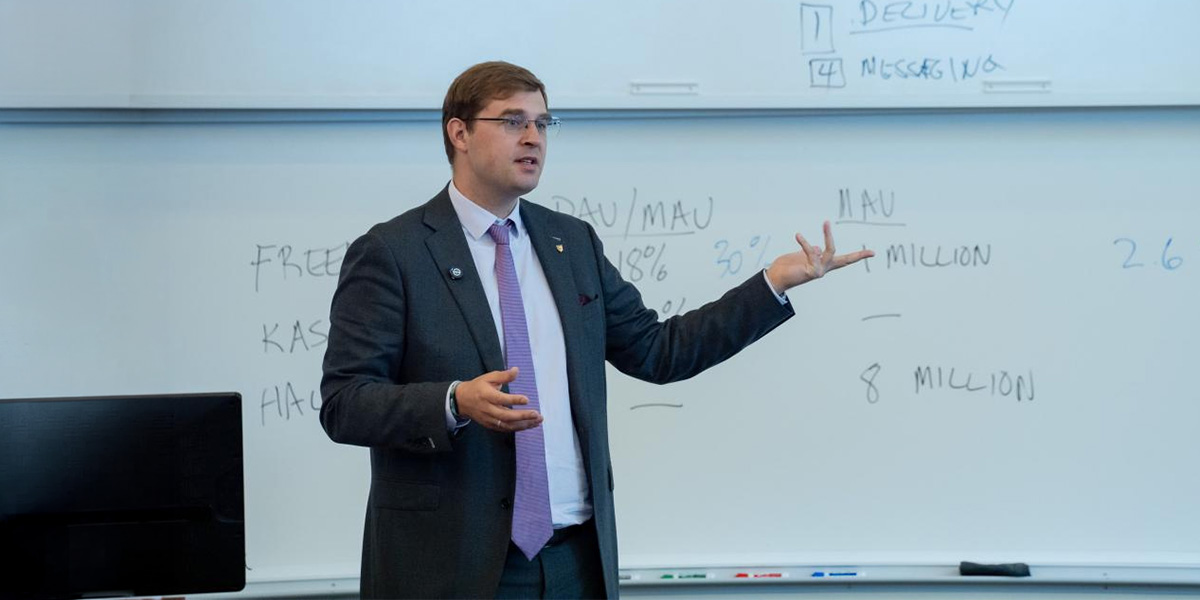
Freedom Holding has become a case study at one of the world’s leading business schools. Speaking at Stanford, founder and CEO Timur Turlov explained how a Kazakhstan-based company built a global digital ecosystem and transformed itself from a brokerage business into a broader fintech platform.
A Case Study from Kazakhstan
Stanford Graduate School of Business is widely regarded as one of the world’s premier institutions for business education, producing talent for many of the largest global technology companies. The California-based university regularly selects contemporary business cases for discussion with students — typically focusing on American or European corporations. This time, however, students, faculty members and Silicon Valley entrepreneurs turned their attention to the story of Freedom Holding Corp.
The Freedom case has drawn interest from future executives and business leaders because of the company’s trajectory: a local firm from a developing economy that built an international business, listed on Nasdaq and increased its market capitalization more than tenfold since its IPO. Stanford views the company’s development not only as a commercial success, but also as a valuable example of how businesses from emerging markets are increasingly establishing themselves on the global stage. And the example of Freedom could be considered one of the most illustrative.
“Speaking the Same Language as the Global Tech Community”
The lecture was delivered by Freedom founder and CEO Timur Turlov himself. “The audience asked thoughtful and genuinely relevant questions. What matters most is that today we increasingly speak the same language as the global technology community: our experience and success stories in Kazakhstan generate sincere interest,” Turlov said.
At the center of the discussion was Freedom’s ecosystem-driven strategy, which the company says has fueled growth both within Kazakhstan and internationally. Rather than focusing solely on expanding its brokerage business and opening offices abroad, Turlov opted to diversify the company’s assets and services. That strategy ultimately led to the creation of Freedom Bank.
For millions of users, banking services represent the first step into digital finance. After building banking infrastructure, the company expanded into adjacent areas, including investments, insurance, travel services and e-commerce. Turlov told students that acquiring a bank became a strategic decision that reduced customer acquisition costs while strengthening trust in the Freedom brand.
“Value is created not by individual products, but by the connections between them. The more services a person uses within a single ecosystem, the greater their engagement and trust,” Turlov said during the discussion at Stanford.[1]
The Freedom Case at Stanford
Stanford Graduate School of Business published its research case study on Freedom Holding in the summer of 2025. The paper examines how the company seeks to create sustainable competitive advantages through integration, user-behavior analytics and long-term strategic planning.
Stanford researchers also explore what growth trajectory may prove optimal for Freedom in the coming years. MBA students identified three potential strategic paths:
- strengthening Freedom’s position in Kazakhstan to outperform local competitors;
- horizontally expanding operations across existing international markets;
- entering entirely new regions, including Southeast Asia and the Middle East.
Expanding the Freedom Ecosystem
Freedom Holding’s ecosystem now serves more than 11 million users, while the company’s SuperApp has surpassed 5 million clients.
The holding company’s shares were added to the Russell 3000 index, which tracks the performance of the largest U.S. public companies and represents roughly 98% of the investable American equity market. Inclusion in the index reinforced Freedom’s status among institutional investors and underscored the stability of its business model.
Last year, major institutional investors including BlackRock, Vanguard, Morgan Stanley and JPMorgan Chase increased their exposure to Freedom shares, alongside hedge funds such as Citadel and Millennium Management.
At the same time, Freedom Holding continues to scale its ecosystem model beyond Kazakhstan. The group now operates in more than 20 countries. Its first attempt to replicate the Kazakhstan model abroad was tested in Tajikistan, which company executives described as successful.
The next step involves expanding brokerage and banking operations in Turkey, a market of roughly 90 million people. The company is also exploring potential banking acquisitions in Armenia and France.
Other news
 From First Investments to Nasdaq: How Timur Turlov Built His F...
 President Tokayev Congratulates Timur Turlov on His Election a...
 Timur Turlov: Freedom Is Developing an AI Assistant for Custom...
 “Armenia Can Become a Bridge Between Europe and Central Asia” ...
 Timur Turlov elected FIDE president: what he plans to change i...
 Timur Turlov spoke to ChessBase about what chess teaches us – ...
 FIDE Presidential Election in Samarkand: Timur Turlov’s Campai...
 Freedom Media Agrees to Cooperate with South Korean Broadcaste...